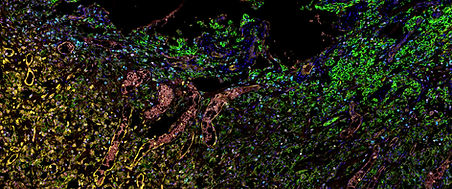
Glioblastoma remodeling of human neural circuits decreases survival.
1. 논문 제목: Glioblastoma remodeling of human neural circuits decreases survival.
2. 저자명: Saritha Krishna, Abrar Choudhury, Michael B. Keough, Kyounghee Seo, Lijun Ni, Sofia Kakaizada, Anthony Lee, Alexander Aabedi, Galina Popova, Benjamin Lipkin, Caroline Cao, Cesar Nava Gonzales, Rasika Sudharshan, Andrew Egladyous, Nyle Almeida, Yalan Zhang, Annette M. Molinaro, Humsa S. Venkatesh, Andy G. S. Daniel, Kiarash Shamardani, Jeanette Hyer, Edward F. Chang, Anne Findlay, Joanna J. Phillips, Srikantan Nagarajan, David R. Raleigh, David Brang, Michelle Monje, Shawn L. Hervey-Jumper
3. 출처 및 게재 (발행일): Nature, 03 May 2023
5. Abstract:
Gliomas synaptically integrate into neural circuits. Previous research has demonstrated bidirectional interactions between neurons and glioma cells, with neuronal activity driving glioma growth and gliomas increasing neuronal excitability. Here we sought to determine how glioma-induced neuronal changes influence neural circuits underlying cognition and whether these interactions influence patient survival. Using intracranial brain recordings during lexical retrieval language tasks in awake humans together with site-specific tumour tissue biopsies and cell biology experiments, we find that gliomas remodel functional neural circuitry such that task-relevant neural responses activate tumour-infiltrated cortex well beyond the cortical regions that are normally recruited in the healthy brain. Site-directed biopsies from regions within the tumour that exhibit high functional connectivity between the tumour and the rest of the brain are enriched for a glioblastoma subpopulation that exhibits a distinct synaptogenic and neuronotrophic phenotype. Tumour cells from functionally connected regions secrete the synaptogenic factor thrombospondin-1, which contributes to the differential neuron–glioma interactions observed in functionally connected tumour regions compared with tumour regions with less functional connectivity. Pharmacological inhibition of thrombospondin-1 using the FDA-approved drug gabapentin decreases glioblastoma proliferation. The degree of functional connectivity between glioblastoma and the normal brain negatively affects both patient survival and performance in language tasks. These data demonstrate that high-grade gliomas functionally remodel neural circuits in the human brain, which both promotes tumour progression and impairs cognition.
6. 한글 초록 요약본:
교모세포종은 인간 뇌의 정상 신경회로와 기능적으로 통합되어 신경회로를 재구성하며 이러한 변화는 인지 기능 저하와 생존율 감소와 밀접하게 연관됨. 본 연구는 각성 상태의 교모세포종 환자에서 언어 과제 수행 중 뇌 전기생리 (ECoG)와 뇌자도 (MEG)를 분석하고 기능적 연결성에 따라 종양 조직을 분자적으로 비교함. 그 결과, 종양에 침윤된 피질은 정상 뇌에서 활성화되지 않는 영역까지 과제 관련 신경활동을 보였으며, 고기능 연결성 종양 부위에는 시냅스 형성을 촉진하는 thrombospondin-1 (TSP-1)을 발현하는 종양세포 아형이 풍부하게 존재함. TSP-1은 신경-종양 상호작용과 종양 증식을 촉진하였고, gabapentin에 의한 TSP-1 억제는 종양 증식을 감소시킴. 또한 종양의 기능적 연결성 증가는 환자의 생존율 감소 및 언어 수행 능력 저하와 유의한 상관관계를 보임.
7. 한글 논문 요약본 (Intro, Methods, Results)
1) Introduction: 교모세포종은 가장 공격적인 원발성 뇌종양으로, 평균 생존 기간이 짧고 치료 저항성이 높은 것으로 알려져 있음. 최근 연구들은 교모세포종이 단순히 신경세포를 압박하거나 파괴하는 것이 아니라, 신경세포와 시냅스를 형성하며 신경회로에 통합된다는 사실을 제시해왔음. 특히 신경세포의 활동은 neuroligin-3, BDNF 분비 및 AMPA 수용체 매개 시냅스를 통해 종양 성장을 촉진하며, 반대로 종양은 글루탐산 분비나 시냅스 형성 인자를 통해 신경 흥분성을 증가시킴. 그러나 이러한 상호작용이 실제 인간의 고차 인지 기능을 담당하는 신경회로에 어떤 변화를 일으키는지, 그리고 이러한 변화가 임상적 예후 (생존율, 인지 기능)에 어떤 영향을 미치는지는 명확히 규명되지 않았음. 본 연구는 각성 상태에서의 인간 뇌 전기생리 기록과 종양 조직의 분자생물학적 분석을 직접 연결함으로써, 교모세포종이 인간 신경회로를 어떻게 재구성하며 이 과정이 종양의 악성도와 환자 예후에 어떤 의미를 갖는지 규명하고자 함.
2) Methods:
2-1) 환자 및 뇌 기능 측정: 각성 수술 중 언어 과제 수행 환자에서 ECoG 기록, 고감마 (high-gamma) 신호를 통한 신경활동 분석
2-2) 기능적 연결성 분석: MEG 기반 종양 내 기능적 연결성 계산, 고기능 연결성 (HFC) 및 저기능 연결성 (LFC) 종양 부위 구분
2-3) 분자 및 조직 분석: HFC/LFC 종양 조직에서 bulk 및 single-cell RNA seq, TSP-1 발현 면역조직화학 분석
2-4) 기능 검증 실험: 환자 유래 종양 세포-신경세포 공배양, 신경 오가노이드 및 MEA 전기생리 분석, 마우스 xenograft 모델에서 종양 성장 평가
2-5) 치료 개입: gabapentin을 이용한 TSP-1 기능 억제 효과 분석
3) Results
3-1) 교모세포종 침윤 피질의 비정상적 신경활동: 언어 과제 수행 시 종양 침윤 영역 전반에서 과제 관련 신경활동 관찰, 정상 뇌에서는 활성화되지 않는 영역까지 언어 회로에 포함됨.
3-2) 종양 내 기능적 연결성의 이질성: MEG 분석을 통해 종양 내부에서 고기능 연결성 (HFC)과 저기능 연결성 (LFC) 영역 구분, HFC 영역은 정상 신경회로와 더 강하게 동기화됨.
3-3) HFC 종양의 분자적 특징: HFC 조직에서 시냅스 형성 및 신경발달 관련 유전자 발현 증가, thrombospondin-1 (TSP-1)을 발현하는 종양 세포 아형이 선택적으로 풍부함.
3-4) TSP-1 매개 신경-종양 상호작용: HFC 종양 세포는 신경세포와의 공배양에서 시냅스 형성과 신경 네트워크 흥분성 증가, LFC 종양 세포에 TSP-1 처리 시 HFC 유사 특성 획득
3-5) 종양 성장 및 침윤성 증가: HFC 종양 세포는 증식률 및 종양 미세관 형성 증가, 마우스 이식 모델에서 종양 성장 가속 및 생존 기간 단축
3-6) 임상적 연관성: 종양의 기능적 연결성 증가는 환자의 생존율 감소와 유의한 상관관계, 언어 수행 능력 저하와도 연관됨.
3-7) 치료적 개입 가능성: Gabapentin에 의한 TSP-1 억제는 신경-종양 상호작용 및 종양 증식 감소
8. 대표 figure
ExtendedData Fig. Experimental workflow


댓글