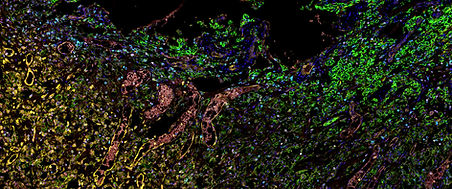
Locoregional delivery of IL-13Rα2-targeting CAR-T cells in recurrent high-grade glioma: a phase 1 trial
Christine E. Brown, Jonathan C. Hibbard, Darya Alizadeh, M. Suzette Blanchard, Heini M. Natri, Dongrui Wang, Julie R. Ostberg, Brenda Aguilar, Jamie R. Wagner, Jinny A. Paul, Renate Starr, Robyn A. Wong, Wuyang Chen, Noah Shulkin, Maryam Aftabizadeh, Aleksandr Filippov, Ammar Chaudhry, Julie A. Ressler, Julie Kilpatrick, Paige Myers-McNamara, Mike Chen, Leo D. Wang, Russell C. Rockne, Joseph Georges, Jana Portnow, Michael E. Barish, Massimo D’Apuzzo, Nicholas E. Banovich, Stephen J. Forman & Behnam Badie
Nature Medicine volume 30, pages1001–1012 (2024) Cite this articleDOI https://doi.org/10.1038/s41591-024-02875-1
Abstract
Chimeric antigen receptor T cell (CAR-T) therapy is an emerging strategy to improve treatment outcomes for recurrent high-grade glioma, a cancer that responds poorly to current therapies. Here we report a completed phase I trial evaluating IL-13Rα2-targeted CAR-T cells in 65 patients with recurrent high-grade glioma, the majority being recurrent glioblastoma (rGBM). Primary objectives were safety and feasibility, maximum tolerated dose/maximum feasible dose and a recommended phase 2 dose plan. Secondary objectives included overall survival, disease response, cytokine dynamics and tumor immune contexture biomarkers. This trial evolved to evaluate three routes of locoregional T cell administration (intratumoral (ICT), intraventricular (ICV) and dual ICT/ICV) and two manufacturing platforms, culminating in arm 5, which utilized dual ICT/ICV delivery and an optimized manufacturing process. Locoregional CAR-T cell administration was feasible and well tolerated, and as there were no dose-limiting toxicities across all arms, a maximum tolerated dose was not determined. Probable treatment-related grade 3+ toxicities were one grade 3 encephalopathy and one grade 3 ataxia. A clinical maximum feasible dose of 200 × 106 CAR-T cells per infusion cycle was achieved for arm 5; however, other arms either did not test or achieve this dose due to manufacturing feasibility. A recommended phase 2 dose will be refined in future studies based on data from this trial. Stable disease or better was achieved in 50% (29/58) of patients, with two partial responses, one complete response and a second complete response after additional CAR-T cycles off protocol. For rGBM, median overall survival for all patients was 7.7 months and for arm 5 was 10.2 months. Central nervous system increases in inflammatory cytokines, including IFNγ, CXCL9 and CXCL10, were associated with CAR-T cell administration and bioactivity. Pretreatment intratumoral CD3 T cell levels were positively associated with survival. These findings demonstrate that locoregional IL-13Rα2-targeted CAR-T therapy is safe with promising clinical activity in a subset of patients. ClinicalTrials.gov Identifier: NCT02208362.
초록(Abstract)
1. 연구 배경
- 키메라 항원 수용체 T세포(CAR-T) 치료: 현재 치료법에 잘 반응하지 않는 재발성 고등급 신경교종 환자의 치료 결과 개선을 위한 새로운 치료 전략
2. 연구 개요
· 연구 단계: 1상 임상시험
· 연구 대상: 재발성 고등급 신경교종 환자 65명(대부분 재발성 교모세포종, rGBM)
· 치료 방법: IL-13Rα2 표적 CAR-T 세포 치료
· 일차 평가 목적: 안전성, 실행 가능성, 최대내약용량(MTD), 최대실행가능용량(MFD) 및 2상 임상시험 권장 용량 계획 평가
· 이차 평가 목적: 전체 생존기간(OS), 치료 반응, 사이토카인 변화 및 종양 면역환경 바이오마커 평가
3. 투여 방법 및 제조 공정
· 투여 경로: 종양 내 투여(ICT), 뇌실 내 투여(ICV), 종양 내/뇌실 내 병용 투여(ICT/ICV)
· 제조 방식: 2가지 제조 플랫폼 평가
· 5군(Arm 5): 최적화된 제조 공정 및 종양 내/뇌실 내 병용 투여(ICT/ICV) 적용
4. 안전성 평가
· 전반적인 안전성: 국소 CAR-T 세포 투여는 실행 가능하였으며 내약성이 양호하였음.
· 용량제한독성(DLT): 모든 군에서 발생하지 않아 최대내약용량(MTD)은 결정되지 않음.
· Grade 3 이상 독성: 치료 관련성이 있을 것으로 추정되는 뇌병증 1건 및 운동실조 1건 발생
5. 최대 투여 용량
· 5군(Arm 5): 1회 투여 주기당 CAR-T 세포 200×10⁶개 달성
· 기타 군: 제조상의 실행 가능성 문제로 해당 용량을 시험하지 않았거나 달성하지 못함.
· 2상 권장 용량: 본 임상시험 결과를 바탕으로 향후 연구에서 추가 조정 예정
6. 치료 반응
· 안정병변(SD) 이상: 58명 중 29명(50%)
· 부분관해(PR): 2명
· 완전관해(CR): 1명
· 추가 완전관해: 임상시험 계획서에 따른 치료 종료 후 추가 CAR-T 투여 주기를 시행한 환자에서 1건 확인
7. 전체 생존기간(OS)
· 전체 rGBM 환자: 전체 생존기간 중앙값(mOS) 7.7개월
· 5군(Arm 5): 전체 생존기간 중앙값(mOS) 10.2개월
8. 면역학적 바이오마커
· 염증성 사이토카인: CAR-T 세포 투여 후 중추신경계 내 IFNγ, CXCL9, CXCL10 증가 확인
· 생물학적 활성: 염증성 사이토카인 증가는 CAR-T 세포 투여 및 생물학적 활성과 관련됨.
· CD3 T세포: 치료 전 종양 내 CD3 T세포 수치가 높을수록 생존기간이 긴 양의 상관관계 확인
9. 연구 결론
· 안전성 및 실행 가능성: 국소 IL-13Rα2 표적 CAR-T 세포 치료는 안전하고 실행 가능한 것으로 확인됨.
· 임상적 유효성: 일부 환자에서 유망한 임상적 활성을 확인함.


댓글