
Lifelong De Novo Aneurysm Risk After Aneurysmal Subarachnoid Hemorrhage in Young Survivors
2026년 8월24일
JAMA Neurol Published Online: August 24, 2026
DOI: 10.1001/jama.2026.2830
Abstract
Importance Young survivors of aneurysmal subarachnoid hemorrhage (aSAH) risk de novo aneurysm formation, yet population-based lifetime estimates are lacking, and prior studies were limited by selection bias and short follow-up.
Objectives To determine lifetime cumulative incidence, risk factors, and rupture rate of radiologically detected de novo aneurysm formation in young survivors of aSAH and the association with smoking cessation.
Design, Setting, and Participants This cohort study used a prospective regional register cross-linked with national health and death registers, with index events from 1967 to 2014. Participants were residents of the Stockholm region, Sweden, and younger than 40 years with an index saccular aSAH. Eligibility required concurrent 4-vessel angiography and retention of original imaging and medical records. Radiological follow-up reached 57 years; de novo aneurysm detection, treatment, recurrent hemorrhage, and vital status were ascertained nationwide through December 31, 2025, and validated longitudinally.
Exposures Age, sex, smoking status, family history, hypertension, and multiple aneurysms.
Main Outcomes and Measures Cumulative incidence of de novo formation, independent risk factors, annual rupture rate, and smoking-cessation association.
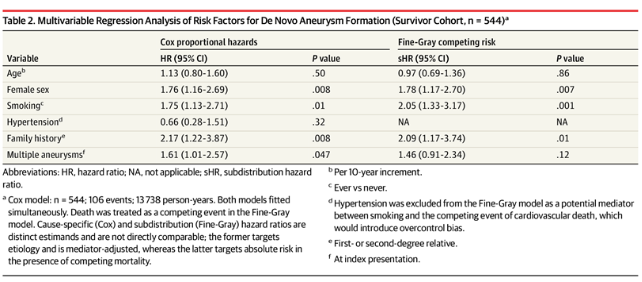
Results Of 6521 patients of all ages with regional saccular aSAH, 986 (15.1%) were younger than 40 years. After eligibility criteria were assessed, there were 544 survivors (83.3%). Among them, 313 were female (57.5%) and 231 (42.5%) male; the median (IQR) age was 33 (28-36) years. Over 13 738 person-years, 106 patients (19.5%) developed 158 de novo aneurysms; 23 ruptured. The Fine-Gray cumulative incidence was 30.2% (95% CI, 24.7%-35.7%) at 40 years, without a plateau. Independent risk factors were female sex (hazard ratio [HR], 1.76; 95% CI, 1.16-2.69), smoking (HR, 1.75; 95% CI, 1.13-2.71), and family history (HR, 2.17; 95% CI, 1.22-3.87). Smoking cessation was associated with lower, dose-dependent de novo risk. The annual rupture rate was 153 per 100 000 person-years. No ruptures occurred under systematic surveillance; one-third occurred more than 20 years after the index event.
Conclusions and Relevance This study found that young survivors of aSAH face a substantial lifetime risk of de novo aneurysm formation that does not plateau over 4 decades. Female sex, smoking status, and family history are independent risk factors; smoking cessation is a modifiable prevention target. These findings support lifelong surveillance and address current guideline gaps.
Key Points
Question What is the lifetime risk of de novo intracranial aneurysm formation, and which risk factors are modifiable, in young survivors of saccular aneurysmal subarachnoid hemorrhage (aSAH)?
Findings In this cohort study with radiological follow-up to 57 years, cumulative incidence of de novo formation, with death as a competing event, reached 30% at 40 years without plateau. Female sex, smoking, and family history were independent risk factors; smoking cessation was associated with lower, dose-dependent de novo risk, and no de novo aneurysms ruptured under systematic radiological surveillance.
Meaning These findings support lifelong radiological surveillance and smoking cessation counseling for young survivors of aSAH.

요약
· 중요성 동맥류성 지주막하출혈(aSAH)을 경험한 젊은 생존자는 새로운(de novo) 뇌동맥류가 발생할 위험이 있지만, 일반 인구집단을 기반으로 한 평생 발생 위험에 대한 추정치는 아직 부족하다. 또한 기존 연구들은 선택 편향(selection bias)과 짧은 추적관찰 기간이라는 한계가 있었다.
· 목적 젊은 aSAH 생존자에서 영상검사로 확인된 de novo 뇌동맥류의 평생 누적 발생률(lifetime cumulative incidence), 위험인자 및 파열률을 평가하고, 금연(smoking cessation)과 de novo 뇌동맥류 발생 간의 연관성을 규명하고자 하였다.
· 연구 설계, 장소, 대상자 본 코호트 연구는 전향적으로 구축된 지역 등록자료(prospective regional register)를 국가 보건 및 사망 등록자료(national health and death registers)와 연계하여 분석하였으며, 최초 사건(index event)은 1967년부터 2014년 사이에 발생한 경우를 대상으로 하였다.
연구 대상자는 스웨덴 스톡홀름 지역 거주자로서, 최초 낭성 동맥류성 지주막하출혈(saccular aSAH) 발생 당시 40세 미만인 환자였다.
연구 참여를 위해서는 aSAH 발생 당시 4-vessel cerebral angiography를 시행받았고, 당시의 원본 영상자료와 의무기록이 보존되어 있어야 했다.
영상학적 추적관찰 기간은 최대 57년이었으며, de novo aneurysm의 발견 및 치료, 재출혈(recurrent hemorrhage), 생존 여부(vital status)를 2025년 12월 31일까지 스웨덴 전국 단위 자료를 통해 확인하고 장기간에 걸쳐 검증하였다.
· 노출 연령, 성별, 흡연 상태, 가족력, 고혈압 및 다발성 뇌동맥류 여부
· 주요 결과 및 측정치 De novo 뇌동맥류의 누적 발생률, 독립적 위험인자, 연간 파열률 및 금연과 de novo 뇌동맥류 발생 위험 간의 연관성
· 결과 지역 내 전체 연령의 낭성 동맥류성 지주막하출혈(saccular aSAH) 환자 6,521명 중 986명(15.1%)이 40세 미만이었다. 연구 참여 적격성 기준을 평가한 후 최종적으로 544명의 생존자(83.3%)가 연구에 포함되었다.
이 중 여성은 313명(57.5%), 남성은 231명(42.5%)이었으며, 연령 중앙값은 33세(IQR 28–36세)였다.
총 13,738 person-years(인년)의 추적관찰 기간 동안 106명(19.5%)의 환자에서 총 158개의 de novo 뇌동맥류가 발생하였으며, 이 가운데 23개가 파열되었다.
Fine-Gray 모형으로 추정한 de novo 뇌동맥류의 40년 누적 발생률은 30.2%(95% CI, 24.7–35.7%)였으며, 시간이 경과해도 발생률 곡선은 plateau(정체 상태)에 도달하지 않았다.
De novo 뇌동맥류 발생의 독립적인 위험인자는 여성(HR 1.76; 95% CI, 1.16–2.69), 흡연(HR 1.75; 95% CI, 1.13–2.71), 그리고 가족력(HR 2.17; 95% CI, 1.22–3.87)이었다.
금연은 de novo 뇌동맥류 발생 위험 감소와 연관되었으며, 금연 정도에 따라 위험이 감소하는 용량-의존적(dose-dependent) 관계가 관찰되었다.
De novo 뇌동맥류의 연간 파열률은 100,000 person-years당 153건이었다. 체계적인 영상 추적관찰(systematic surveillance)을 받고 있던 기간에는 파열이 한 건도 발생하지 않았으며, 전체 파열의 약 3분의 1은 최초 aSAH(index event) 발생 후 20년 이상 지난 시점에서 발생하였다.
· 결론 및 임상적 의의 본 연구에서는 젊은 aSAH 생존자에서 de novo 뇌동맥류가 발생할 평생 위험이 상당히 높으며, 그 위험은 40년에 걸쳐서도 정체(plateau)에 도달하지 않고 지속적으로 증가하는 것으로 나타났다. 여성, 흡연 및 가족력은 de novo 뇌동맥류 발생의 독립적인 위험인자였으며, 금연은 중재 가능한 예방 전략(modifiable prevention target)으로 확인되었다. 이러한 결과는 젊은 aSAH 생존자에 대한 평생 영상 추적관찰(lifelong surveillance)의 필요성을 뒷받침하며, 현재 가이드라인에서 명확히 제시되지 않은 장기 추적관리의 공백을 보완하는 근거를 제공한다.


댓글