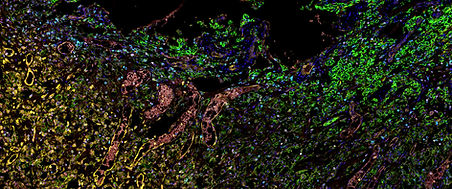
A bioavailable GPX4 inhibitor for ferroptosis induction in vivo and tumor suppression
Nathchar Naowarojna, Xin Gu, Zijian Pan, Tao Peng, Yikai Wang , Yilong Zou,
2026, Cell 189, 1–15
초록
Ferroptosis is implicated in multiple human diseases, but the lack of bioavailable inducers has limited its physiological study and therapeutic translation. Here, we report KY0418, a selective covalent inhibitor of glutathione peroxidase 4 (GPX4) featuring an isourea warhead, with high plasma stability and broad tissue distribution after oral dosing in mice. KY0418 specifically targets GPX4SeCys46 to induce ferroptosis hallmarks in human and mouse cancer cell lines, with greater selectivity than existing inhibitors. In a standardizable
acute-liver-injury mouse model, KY0418 triggers ferroptotic ultrastructural changes matching those of established inducers, and systemic administration remodels tissue metabolism and generates hydroxyl radicals detectable by a chemiluminescent probe. Subcutaneous tumors from different cancers exhibited variable responses to KY0418 treatment, from no effect to about 70% growth inhibition, but KY0418 consistently eradicated circulating tumor cells and suppressed metastasis across multiple cancer models. These findings position KY0418 as a tool for advancing in vivo ferroptosis research and its clinical translation.
논문 요약
본 연구는 기존 GPX4 inhibitor의 낮은 plasma stability와 제한적인 in vivo applicability를 개선하기 위해 bioavailable covalent GPX4 inhibitor인 KY0418을 개발하고, 이를 이용하여 생체 내 ferroptosis 유도 및 항암효과를 평가하였다. 연구진은 기존 chloroacetamide 및 propiolamide warhead의 metabolic instability와 cysteine reactivity를 고려하여, comparative pharmacophore analysis를 통해 low-molecular-weight, amide-free DPI17 scaffold를 starting point로 선정하였다. 이후 chloride bioisostere screening을 통해 isourea warhead를 도입하고 scaffold와 substituent를 최적화하여 최종적으로 KY0418을 개발하였다.
KY0418은 purified GPX4 enzymatic assay에서 GPX4 활성을 직접 억제하였으며, molecular modeling에서는 pyrimidine ring과 Gly47 사이의 hydrogen bond 및 pyridine ring과 Trp136 사이의 π–π interaction이 제시되었다. Intact-protein MS와 tandem MS를 통해 KY0418이 GPX4의 catalytic SeCys46에 covalently binding하는 것이 확인되었으며, 기존 GPX4 inhibitors와 비교하여 predominantly single-site modification을 나타냈다. 또한 KY0418의 alkyne probe인 KY-yne (KY0528)을 이용한 chemical proteomics와 GPX4 mutant 분석을 통해 cellular target engagement와 GPX4 의존성이 검증되었다.
세포 수준에서 KY0418은 다양한 ferroptosis-sensitive cancer cells의 viability를 감소시켰으며, 이러한 효과는 Liproxstatin-1과 deferoxamine에 의해 억제되었다. KY0418 처리 후 oxidized PUFA-phospholipid와 BODIPY-C11 oxidation이 증가하고 ferroptosis-associated mitochondrial alterations가 관찰되어, GPX4 inhibition에 따른 lipid peroxidation과 ferroptosis induction이 확인되었다. 또한 acute liver injury model에서 KY0418은 4-HNE accumulation과 mitochondrial 및 ER abnormalities를 유도하였으며, 이러한 변화 역시 Lip-1에 의해 완화되어 in vivo ferroptosis induction이 확인되었다.
KY0418은 mouse에서 3 mg/kg 경구투여 시 68.8%의 oral bioavailability와 약 2시간의 plasma half-life를 나타내어 systemic administration이 가능한 pharmacokinetic profile을 보였다. 경구투여 후 여러 조직으로 분포하였으며 systemic GPX4 inhibition에 따라 liver, kidney 및 spleen에서 lipid peroxidation과 histological alterations가 관찰되었다. 반면 blood-brain barrier penetration은 제한적이었다. 연구진은 hydroxyl radical-responsive chemiluminescent probe인 DhX-CL4-HR도 개발하여 KY0418에 의해 유도되는 tissue oxidative response를 평가하였다.
항암효과는 tumor model에 따라 차이를 보였으며, subcutaneous tumor growth inhibition은 약 0–70% 범위로 나타났다. 반면 KY0418은 여러 모델에서 circulating tumor cells를 감소시키고 metastatic dissemination을 억제하였다. 또한 LLC1 allograft에서 anti-PD-1과 병용했을 때 약 80–90%의 tumor growth inhibition이 나타났으며, proliferating CD8+ T cells 증가와 tumor-associated neutrophils 감소가 관찰되었다.
종합적으로 본 연구는 DPI17 scaffold와 isourea warhead를 기반으로 GPX4 SeCys46을 선택적으로 covalent targeting하는 KY0418을 개발하고, 이를 통해 cellular 및 systemic ferroptosis를 유도할 수 있음을 입증한 연구이다. KY0418은 in vivo ferroptosis 연구와 GPX4-targeted cancer therapy의 가능성을 평가하기 위한 bioavailable pharmacological tool로 제시되었으나, 연구진은 향후 metabolic stability와 potency를 포함한 추가적인 medicinal-chemistry optimization이 필요하다고 제시하였다.

(A) Pharmacophore analysis of GPX4U46C with modeled DPI17: aromatic ring (orange), H-bond acceptor (pink sphere with arrow), and reactive site (green sphere), and KY0418 with the isourea warhead (red).
(B) Schematic of GPX4 enzymatic assay: TBHP reduction by GPX4-coupled GSH reductase (GR)-mediated nicotinamide adenine dinucleotide phosphate (NADPH)-dependent GSH disulfide reduction.19,32
(C) Reaction-velocity and second derivative Kobs plots vs. KY0418 (left) or ML162 (right); kinact and Ki of purified GPX4-His protein.
(D) Structural modeling of KY0418 (purple stick) in GPX4U46C (brown, PDB: 6HKQ29) revealing key interactions (black dash line), including a H-bond between the Gly47 backbone amide-KY0418 pyrimidine-ring N and a π-π interaction between KY0418’s pyridine ring and Trp136.
(E) Proposed mechanism of KY0418 covalently targeting GPX4SeCys46 to inhibit its activity. Red, isourea warhead.
(F) Deconvoluted intact-protein mass spectra of GPX4 after conjugation with indicated compounds.
(G) MS/MS spectrum of a GPX4-His tryptic peptide showing covalent GPX4SeCys46-KY0418 adduct.
(H) Relative cell viability of human cancer cell lines (CCLs) treated with KY0418 ± cell death inhibitors.
(I) Targeted LC-MS/MS-lipidomics of oxidized PUFA-phospholipids (n = 3) following vehicle, KY0418 ± Lip-1 treatment.
(J) Fluorescence images of BODIPY-C11-stained MDA-MB-231 cells post KY0418 ± Lip-1 treatment. BODIPY-C11red and BODIPY-C11ox: reduced and oxidized BODIPY-C11 signals, respectively.
(K) BODIPY-C11 oxidation levels (left) and median oxidized-to-reduced BODIPY-C11 ratio (right) in SK-HEP-1 cells (n = 3) treated with KY0418 ± Lip-1. Data represent mean ± S.D. of 3 replicates. Statistical significance was calculated by one-way ANOVA analysis.
(L) Transmission electron microscopy (TEM) images of MDA-MB-231 cells treated with KY0418 ± Lip-1. White arrowheads, mitochondrial cristae (CR). Scale bar: 500 nm.
(M) Relative cell viability of indicated patient tumor-derived primary ovarian cancer cells24 treated with KY0418 ± Lip-1.
(N) Schematic (top) and enriched proteins (bottom) from the competitive Cu(I)-catalyzed azide-alkyne cycloaddition (CuAAC) and biotin-streptavidin pull-down followed by LC-MS/MS analysis in human MDA-MB-231 and mouse LLC1 cells (n = 3).
(O) Immunoblots (IB) of CuAAC streptavidin-enriched GPX4 from DMSO- or KY-yne-treated MDA-MB-231. Input, soluble lysate; bound, biotin pull-down.
(P) Relative cell viability of SK-HEP-1 cells stably expressing green fluorescent protein (GFP), GPX4WT, or GPX4U46C treated with indicated compounds.
Cell viability assays, n = 4 wells. Data: mean ± standard deviation (S.D.).


댓글